
Category: Trees & Insects
-

Can Ash Trees be Saved from the Emerald Ash Borer?
What is the Emerald Ash Borer? The Emerald Ash Borer (EAB) is a brilliantly colored green beetle that emerges in May. The EAB has been devastating Ash trees from Michigan to Texas and all along the East coast. The EAB is native to Asia and has no known predators in North America. What Counties in…
-
Insects that Attack Trees in North Texas
Tree Pests in Denton County Our Consulting Arborists encounter many insects afflicting trees in North Texas. Below is a list of the most common insects that infest trees in Denton County and Collin County. Many of the insects are evidence of other stress factors that the tree is dealing with, like poor irrigation (too much…
-

Protecting Pecans, Red Oaks and Blackjacks from the Flatheaded Appletree Borer
Photo: Joseph Berger, Bugwood.org In recent months, our arborists have noticed an increase in disease in pecans, red oaks and blackjacks. This is partially due to infestations by the flatheaded appletree borer (Chrysobothris femorata). Flatheaded Appletree Borer The flatheaded appletree borer is an opportunistic pest that targets weakened or stressed trees. Eggs are laid in…
-
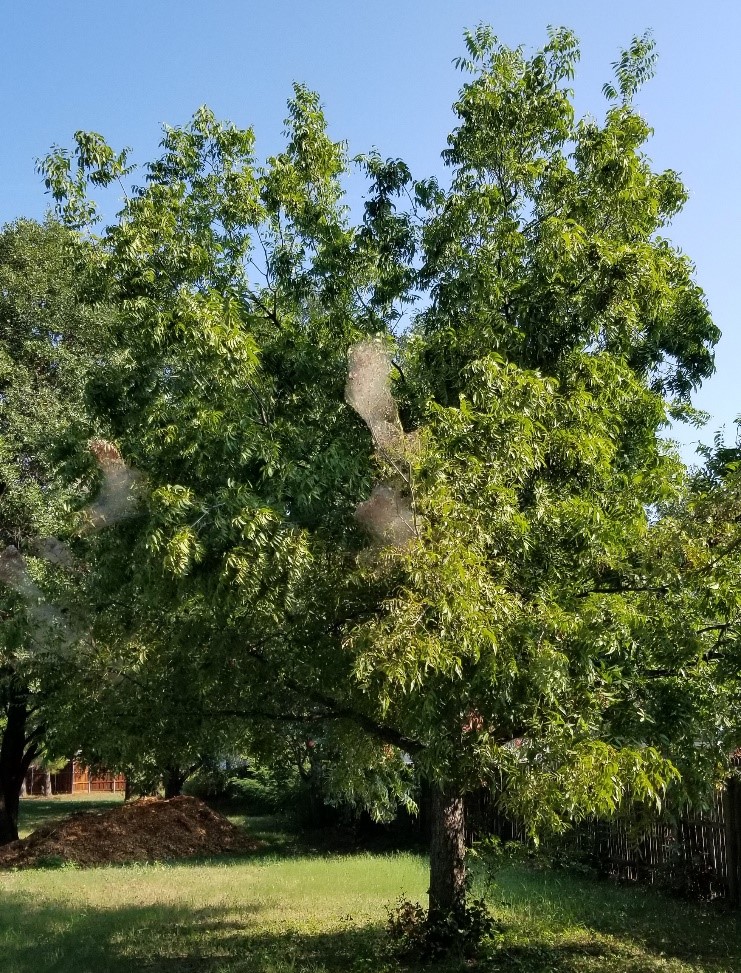
Fall Webworms
Fall webworms are commonly seen in the autumn, as the name suggests. The small, web-forming caterpillar attacks over 88 kinds of plants and trees. In North Texas, Oak, hickory, and pecans trees are the most frequently infested, along with some ornamentals.
-

Why Are Crepe Myrtles Turning Black?
It is a rare neighborhood in North Texas that does not have a crepe myrtle or two planted along its streets. Crepe myrtles bloom in the summer, adding color and pop to any landscape. But like any plant in your yard, crepe myrtles need the right care and treatment, or they could become diseased or…
-

Hackberry Trees: Dying or Under Attack?
Hackberry trees in Denton County are being hit by hard by moth larvae. The small green caterpillar eats the flesh out of the leaves, leaving only the veins. The defoliation can make a hackberry tree appear as if it is dying, but it is not. Pest populations fluctuate along with predator populations. The last time…
-

How to Control Sooty Mold on Crape Myrtles
The sooty mold on your crape myrtles is caused by a sap-feeding insect, known as Crape Myrtle Bark Scale (CMBS). The insect’s excrement, known as honeydew, is sugary. Eventually, the sugary honeydew becomes moldy, turning the beautiful limbs of a crape myrtle dark and sticky. Like any mold, it can be cleaned up with mild dish…
-

Keys to Managing Emerald Ash Borer Infestation in Your Ash Trees
As mentioned before on this blog, the Emerald Ash Borer (EAB) has been detected in Denton County. If you own any ash trees, they could become infested. And while infestation is not certain, we recommend that you make an inventory of the ash trees on your property. Having them inspected by an ISA Certified Arborist…
-
How to Protect Ash Trees from the Emerald Ash Borer
The Emerald Ash Borer (EAB) has killed billions of ash trees in the United States, and as one researcher has stated, “it is likely to kill billions more.” The exotic pest is a serious threat to ash trees in the United States. While the outlook is not positive, ash tree owners do have options. In…
-

What are those strange growths on tree leaves?
Leaf Galls and Wasps The strange growths on the back of the leaves, such as those picture below, are known as leaf galls. Galls are formed when a wasp lays an egg. Along with the egg(s), the wasp secrets a growth regulating chemical which causes the leaf or stem to swell. The resulting swelling is…