
Author: Scott Geer
-

Fire Blight and Ornamental Pears
What Is Fire Blight? Every few years, we get a lot of Fire Blight in ornamental pears in Denton County. The disease is caused by a bacteria and enters into the tree’s tissues via open flowers. So, the conditions have to be just right for a tree to get infected flowers open, high humidity, and…
-
High winds? Inspect Your Cedar Elms (and All Trees) Afterward
With the recent storms in Flower Mound and Lewisville, it is an important to inspect your trees for limb cracks. Often a limb may crack in a storm, but not fail completely until a later time, sometimes a few years later. The cedar elm is very prone to developing longitudinal cracks in the limbs, especially…
-

Cedar Elm- A Great Tree, But Prone to Splitting
The Cedar Elm (Ulmus crassifolia) is a great tree for Denton County. It is native and lives well with the other two common native trees ? Post Oak (Quercus stellata) and Blackjack Oak (Quercus marilandica). It is drought tolerant and tolerates a wide range of soil conditions.
-
Italian Cypress Fungal Infections and Solutions
The Italian Cypress is a beautiful upright evergreen that grows in a straight column up to 20 to 25 feet or more. It thrives in North Texas, but can have real problems if: 1) Planted in heavy clay soils 2) Irrigated too much 3) Experience very wet spring and early summer weather The tree comes…
-

Live Oak – A Wonderful Tree but Not Always the Best Choice
Why Live Oaks Thrive in North Texas The Live oak is not native to Denton County but thrives exceptionally well in our area. It is native across the southern gulf coastal plain over into central Texas. There is a variety (or a separate species, depending on the expert) that is native up the west side…
-

The Biggest Weeds in Your Turf Lawn are Your Trees
I try to impress on people that when they are trying to control weeds in their lawn that the largest weed is the trees. The same chemicals that control dandelions, crabgrass and Dallisgrass can also kill your trees. Red oaks are particularly sensitive to herbicides, especially Metsulfuron. I have seen numerous trees this spring that…
-

What Has Happened to My Hackberry Trees?
The unusual weather this year has set up conditions for a very obscure moth to come out of obscurity and defoliate many of the hackberry trees in southern Denton County. The moth larvae is a small green caterpillar about 1/2 inch long at maturity. The caterpillar is called a “skeletonizer” because it eats the flesh…
-

Beautiful Post Oak in Flower Mound
Sometimes developers, the city, and the homeowners get it right. This park is just south of 1171 on Regency Park Court. The “Lone Tree” is a gorgeous Post oak that was spared and became the focal point of this park. The tree is 32.1 inches DBH (diameter at breast height) and has a great crown…
-

Little Round Bugs Invading My Patio and House!
This is not necessarily tree related, but it is something I haven’t seen before at our yard and house in Highland Village, Texas. Over the past few days, thousands of small round insects are covering the back patio and coming into the house. Upon some investigation, these are “White-Lined Burrowing Bugs” and are completely harmless…
-
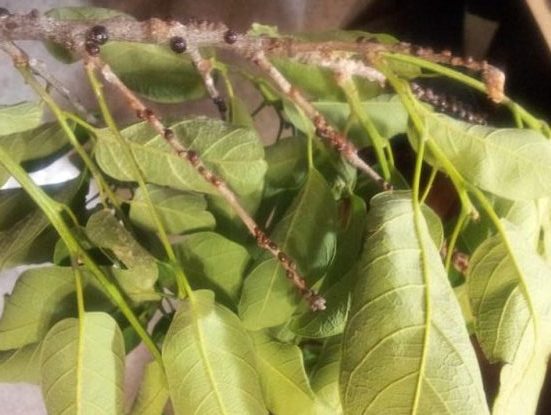
Brown Bumps On My Oak Twigs?
What are those little brown humps that cover my oak twigs? These are lecanium scale insects. The lecanium scale can be debilitating to the host plant, rarely killing it. The insect draws sap from the tree, thus reducing the tree’s resources. A heavy infestation can stress a tree greatly and may cause thinning of the…